Runtime: 68 hr, 39 min
Lectures: 48
A 48-Lecture Odyssey Through the Architecture of Thought in Animals, Fungi, and Swarms
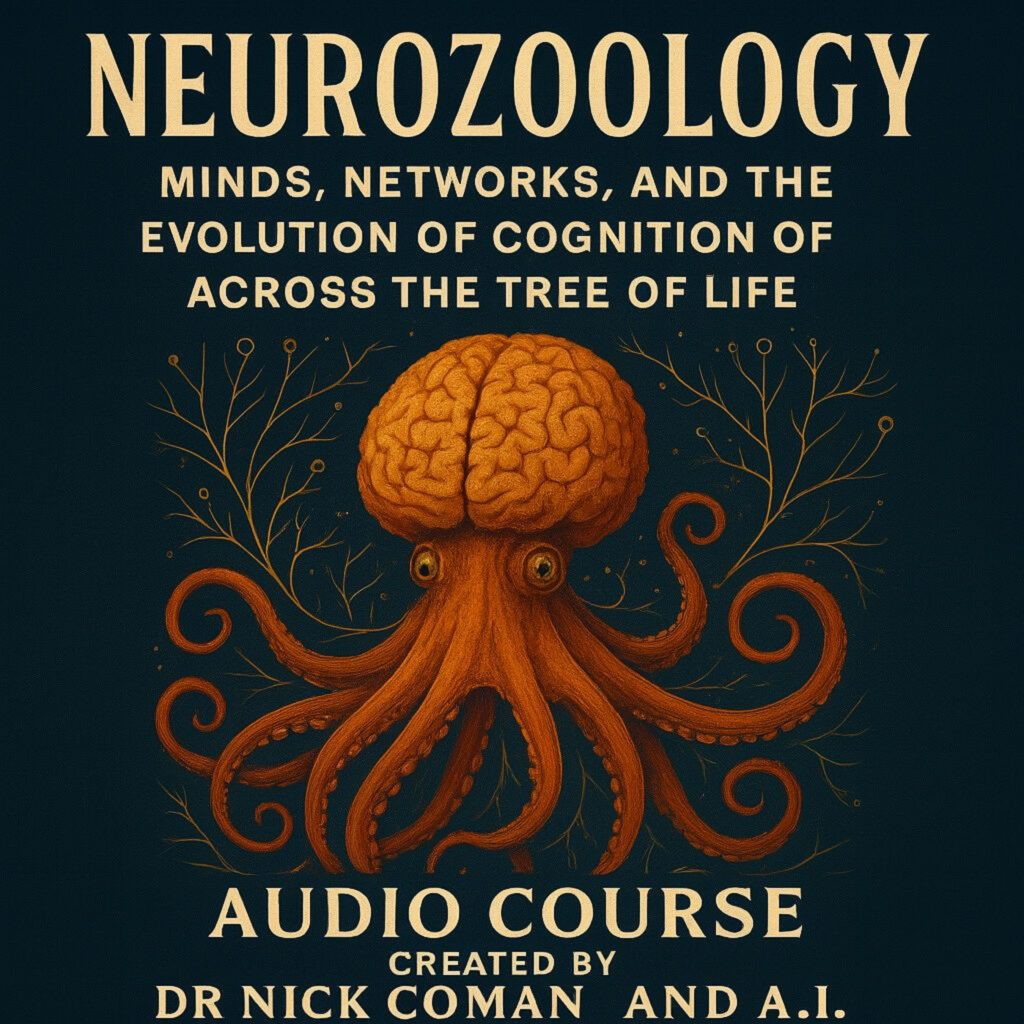
From octopus arms that think for themselves to slime molds that solve mazes without neurons, NeuroZoology takes listeners on an astonishing journey through the minds of creatures great and small-and some without brains at all.
Spanning 48 richly narrated lectures optimized for audiobook format, this course redefines what it means to think, feel, decide, and remember in the animal kingdom. With the rigor of neuroscience and the wonder of natural history, it explores the evolutionary inventions that gave rise to cognition: mycelial signaling networks, insect mushroom bodies, echolocation in bats and whales, grid cells in birds and rats, mirror neurons in apes and parrots, and the tools and cultures of corvids, cephalopods, and primates.
Structured as a tour through deep time and neurodiverse lifeforms, NeuroZoology challenges anthropocentric models of intelligence and introduces a radically ecological view of the mind. You’ll meet brains that regenerate themselves, brains that operate without a cortex, and collective intelligences where no individual is in charge-but the group computes nonetheless.
Whether you’re a neuroscientist, ethologist, educator, or simply someone who wonders what it’s like to be a squid-or a bee, or a bird-this course will change how you think about thinking.
It is not just a study of nervous systems. It’s a meditation on what minds are, where they reside, and how many ways nature has solved the problem of cognition.
69 hours of content across 48 lectures. Full bibliography of 500+ sources included.
Syllabus:
Lecture 1. The First Nerve – Origins of Intelligence
Lecture 2. Distributed Minds
Lecture 3. Origins of Brain–Body Mapping
Lecture 4. Tools, Tongues, and Tentacles
Lecture 5. Neural Time: Introduction
Lecture 6. Mirror Minds: Origins of Empathy
Lecture 7. Neuroplasticity
Lecture 8. Neural Time 2: Duration, Sequence, Rhythm
Lecture 9. Tools, Tricks, and Teleology
Lecture 10. Cognitive Maps and Navigational Intelligence
Lecture 11. Neural Lateralization
Lecture 12. Swarm Systems
Lecture 13. The Shape of Thought: Neural Morphology
Lecture 14. Convergent Minds: Evolutionary Reuse
Lecture 15. Animal Models of Neuroscience
Lecture 16. Architecture of Sensory Worlds
Lecture 17. Memory Without a Brain
Lecture 18. Emergent Intelligence in Swarms
Lecture 19. Cephalopod Brains
Lecture 20. Avian Architects: Corvids and Parrots
Lecture 21. Echolocation and 3D Mapping
Lecture 22. Neural Choreography: Dancing and Synchronization
Lecture 23. The Plastic Brain: Regeneration and Rewiring
Lecture 24. Mirror Minds in Non-Humans
Lecture 25. Neural Cartography and Internal GPS
Lecture 26. Insect Intelligence
Lecture 27. Glial Networks and Non-Neuronal Intelligence
Lecture 28. Comparative Cortices
Lecture 29. Cortical Substitutes in Invertebrates
Lecture 30. Tool Use 2
Lecture 31. Other Minds: Electromagnetic Sensation
Lecture 32. Neural Timing 3: Oscillations and Entrainment
Lecture 33. Intellect: Corvids, Primates, Cephalopods
Lecture 34. Sleeping, Dreaming and Consciousness Across Brains
Lecture 35. Neuroethology of Social Behavior
Lecture 36. Plasticity Without a Cortex
Lecture 37. Brain–Body Coevolution
Lecture 38. Swarm Computation
Lecture 39. NeuroEcology and Niche-Driven Brains
Lecture 40. The Concept of Umwelt
Lecture 41. Tool Use and Abstraction
Lecture 42. Adaptations of the Deep Sea
Lecture 43. Parasitic Minds
Lecture 44. Eusociality: Brains That Serve the Hive
Lecture 45. Tool Use 4: A Final Look
Lecture 46. Mycelial Minds
Lecture 47. Craniocentric Bias
Lecture 48. Future NeuroEcology
You May Also Like: